

Beetling on about a long lost biota…
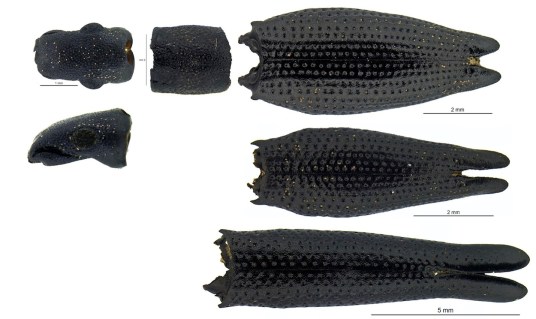
These are beetles. They’re certainly not complete, or even recently alive; they are pieces of an as yet unidentified weevil genus from the remote Indian Ocean island of Rodrigues (look it up). They don’t even belong to a single individual. They’re also minimally 400-500 years old and perhaps as old as 1000 years. They’re insects from sediment samples rather than sweep nets – subfossil or ‘fossil’ insects that tell us a story of past diversity. There’s nothing in the region alive that looks anything like them. They’re a window into a lost world, or an island that was. A story that’s repeated across the Indo-Pacific.
It’s a story that’s been completely ignored. Why? There are many possible reasons and I like to think it’s because it’s a story of little things in a world where big things matter more. That’s probably not true, or at least I hope not. More likely it reflects a combination of our ignorance of the consequences of human colonisation on little things, the difficulty of doing subfossil insect research and the relative rarity of invertebrate researchers. Alternatively no one had thought to look. That’s what I’d rather think.
Last September I spent several weeks on Rodrigues with a colleague of mine, David Burney, taking samples from a collapsed cave called Grotte Fougere. Inside this cave is a pool of water that has been accumulating fossils for as much as 3000 years, almost certainly up to twice as long. It’s probably the richest subfossil insect site I’ve seen and I work on subfossil insects for a living (somebody has to do it and I rapt it me). Grotte Fougere is great because Rodrigues has been almost completely transformed since humans settled there in 1691, when Francois Leguat arrived with his small band or short term colonists.
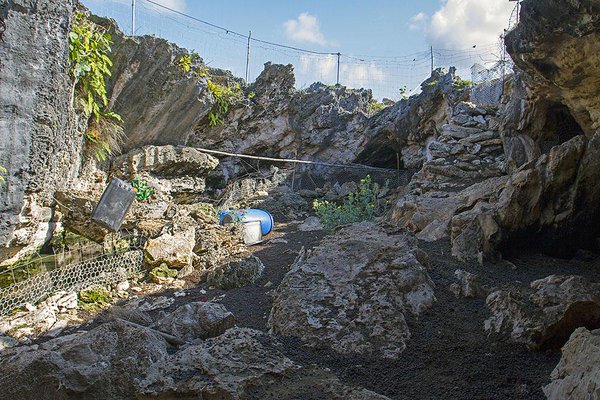
Grotte Fougere in September 2015. Named for the luxuriance of ferns visible on the first visit. Here, on the second visit, it’s effectively a goat pen. Perhaps Grotte de la Crotte de Bique would be a more apt name but that translation has two meanings, one of which is Goat Dung Cave and the other colloquially would be Worthless Cave. It’s certainly not that so we’ll stick with Grotte Fougere.
Rodrigues was hom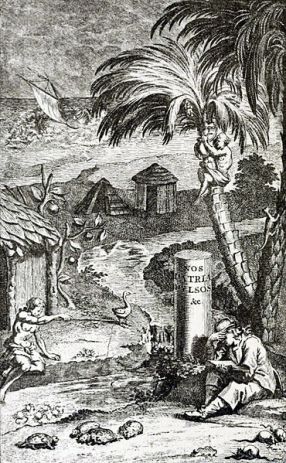 e to a large bird related to the dodo – the solitaire – and was covered with several species of giant tortoise. Today the solitaires and tortoises are all extinct and very little indigenous forest remains, with many of the forest trees and other plants already extinct or endangered. This suggests that lots of other species have been lost too but without an organic fossil record (preserving things like insects and plants rather than mineral bones and snails) it was impossible to tell.
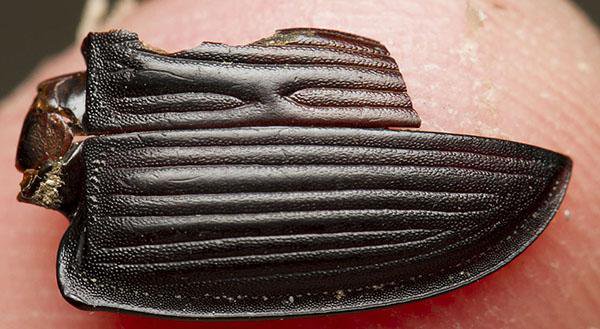
Now we have Grotte Fougere (I spied it looking out the plane window when leaving on my first visit) and every day I’m finding exciting things. Diverse dung beetles where there are none today. Giant ground beetles with their nearest relatives almost 1600 km away in Madagascar. Tiger beetles with rare and endangered relatives on nearby Mauritius. And on and on (and on). So much new stuff, so much fun (rapture), but with a tinge of sadness too because most, if not all, these new things are extinct – decimated by the consequences of human landscape use and attendant changes: fire, goats, forest clearance, rats, invasive ants. One on top of the other. And more too. Some species like the giant carabids (below) probably disappeared rapidly with the arrival of rats. Other species lasted longer until the lowland forest was gone. A few still survive.
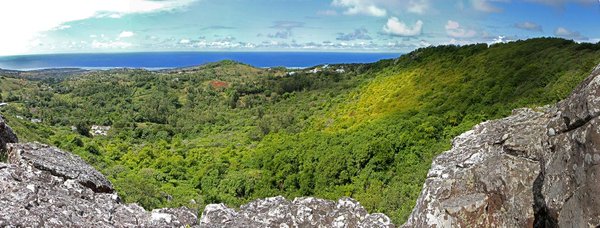
Perhaps saddest of all is that we really don’t even know the modern fauna well. We know enough to know that the above listed groups are missing but there are still native species hanging on in the remnant patches of highland forest like that at Grande Montagne (below – although most of the green is alien and the native a few trees at the base on the cliff). Hopefully, in a few months I’ll be back to Rodrigues to compare what we can find living with what we find dead. Sadly it’s the same almost everywhere. Modelling systems and their charismatic biota is much sexier than actually exploring their unknown diversity
Someday perhaps the fossil record will reveal not just the islands that were, but the world that was.
 MANY LITTLE THINGS